

From the videographer: First time in Somalia
- Remi Bumstead

When you hear of Somalia in the media it is often tied with negative connotations: pirates; Al Shabbab; and famine. So when I got the call from Arete to create some videos for their clients World Food Programme and FAO in Somalia, I was very interested to find out what the stories would be like on the ground.

In Somalia, livestock is key. The majority of people living outside of urban areas rely almost solely on livestock to survive, with cattle, goats, and camels being the key players. Not only do the people of Somalia use milk and meat for their personal consumption, the animals are bought and sold as their main form of currency; one of the main exports of Somalia is livestock. Animals are their lifeline.
In 2017, as Somalia was experiencing its second consecutive year of drought, livestock suffered greatly. Without pasture and water, they became weak. Disease and infection spread, and animals stopped producing milk; they became unsaleable, most of them died, and people’s assets with them. People had no money to purchase simple things like salt, to send their children to school, or to buy food. Somalia was on the brink of famine.

While working with FAO I saw first hand how their interventions brought people back from the brink of famine. Working through local organisations, FAO were able to set up initiatives to assist the local community to create water catchments, which funnelled and collect any rain into small dammed lakes. They did this via the ‘cash for work program’ which not only meant there was the creation of the water catchment, but also that people received an income when there was no other work.

I spoke to many people who told me that this was a lifeline, helping them to buy food and ensure their children were healthy. Once the rains did come, the water collected in the catchments. The few animals that survived now had access to water, and the area around it also created pasture for their feed. It was amazing to see these catchments in this arid environment — especially when we got the drone up to take some footage! From all the people I spoke with while with FAO, it was clear to see that by addressing the needs of animals, they were able to address the needs of the people.
I also spent time with the World Food Programme, and it was inspiring to see first hand how their projects have helped people in response to the drought as well. WFP has historically undertaken food distribution in emergency contexts, although in recent years they have started to use voucher schemes or e-cash in order to distribute food. This entails topping up people’s cash cards, just like a pre-paid debit card, with money they can use to buy goods in local markets and shops. As a result, people are benefitting their local economy, and being given more choice in what they can buy.

In Somalia, phone use is high and mobile internet speeds are fast and relatively cheap. Additionally, people with phones tend to share them with family and friends, so even if someone doesn’t own a phone, most people have access to one. In response to this, World Food Programme have created a new platform building on the e-cash cards, developing it into an app and WFP e-shop. This app works in a similar way to many of our online shopping apps, allowing users to search for food products to buy from local shops and then having it delivered to their door.

The e-shop works with the local stores, updating their stock on the app and showing the price of each item, allowing people to search the shops in their area to see what is available and at what price. Each month, World Food Programme adds people’s allowance onto the e-card, which syncs with the e-shop app. From the many people I spoke to about this programme, the recurring theme was how it has made their lives so much easier and allows them to spend their energy on more important things — like preparing for the next drought.
I learnt that Somalia is definitely not just pirates, Al Shabbab, and famine. I heard amazing stories while I was there, and seeing it was great to see how the World Food Programme and FAO projects are directly improving peoples lives.
About Remi

Remi Bumstead is videographer with 7 years of experience working internationally for a wide range of clients. Some of his clients include UNICEF, FAO, WFP, Restless Development and RedR. He has worked in a number of countries including Uganda, The Gambia, Samoa and India.
From the videographer: First time in Somalia was originally published in Arete Stories on Medium, where people are continuing the conversation by highlighting and responding to this story.

Ethos meets - Kate Holt
Arete is a unique storytelling agency, which works with NGOs, governments and charities, and sources and manages local experts in photography, video, digital and written content from around the world. Jack Atkins caught up with Arete’s founder, award winning photojournalist Kate Holt, to find out more about her process and ideologies…

When do you consider your work on a story to be done?
It’s never really done is it. I always find it frustrating when I walk away from a story and think “Oh God I really should have asked this question” or I like at my set of pictures and think “Oh I really should have shot THAT bit” so I suppose you never really finish, and people’s stories are always unfinished stories aren’t they. I think when we’re striving to tell people’s stories it’s important to get as much information as possible that’s going to engage people with their lives.
What constitutes success; is it getting people talking and raising awareness, or is it direct action?
I think it’s both. A lot of storytelling, especially the type of stories we produce and write and photograph, are about raising awareness because once awareness is raised change happens. I don’t think change is quick, and I think change is very much about changing people’s attitudes, and that’s a much longer and harder journey.
How often do stories come to you, or do you go to them?
A mixture of both really, I have a lot of clients such as Unicef, UNHCR, World Food Programme, the Guardian, and sometimes they’ll come to me and say “right we want you to go out to Iraq and we want you to cover this story and we’ll give you a driver and a translator and you’ll work with our project out there” and I’ll do what they ask for. What I often find is that there’s a bit of a disconnect between people’s expectations and what can actually be produced, because really often the story is not what they think it’s going to be. I like being flexible in that situation, and I encourage my clients to be open minded about what the end result may be.
With regards to commercial work, how hard is it to balance the profitable side with the humanitarian side of the business?
It’s not actually, although I get paid for producing humanitarian stories… one of the things I’ve discovered is that no-one sets out to do a bad job. Particularly charities, UN agencies, government organisations, the likes of Save the Children, Oxfam etc., none of them set out to cause harm. Ultimately we’re all on the same journey, we all want to create a better space and a better place for people to live and work in. So although we get paid for what we do, I think it’s important to keep in mind that even if I see things or I’m asked to do things I don’t like or are unethical, no-one is actually setting out to be unethical.
Have you therefore found that any of your images have been bastardised, or reproduced in a way that skews the narrative?
Yes! All the time! *laughs* No, not all the time, but I’ve definitely had bigger clients who have sometimes manipulated images which has really upset me. But I think since the rise of social media and internet platforms it is much less common now, as people are more aware that they’ll be found out. Before when we were mainly dealing with print media it was a lot easier for people to do that, so I think now there is much a greater autonomous policing because of the internet.
Because you know there is now a lot more transparency within the media, has it effected how you view your work and how you approach stories?
I know now there will be open to a lot more criticism, a lot more scrutiny, and I think that is really healthy for journalists, as I think it’s important that conversations are opened up and that everyone is entitled to their opinion. I think someone like me, I have a lot of experience working in different countries and it’s important that I make people aware that my opinions aren’t coming out of thin air, but a lot of my opinions come from experience out of long periods of time spent in difficult places. I think the internet is a really valuable tool, as you can do a lot more research into a subject as a result of the internet than you ever could before.
So how much do you find yourself relying on the internet for research, or do you still find the most valuable information from the people at the coalface?
To be honest when I go on assignment I do minimal research *laughs* I tend to do it post or when I’m in the field. I quite like arriving at places with fresh eyes and haven’t read to much into a brief or around the history of somewhere, because it’s amazing what you hear that you hadn’t really thought you’d hear. It’s really important to do first hand research and understand things from a personal perspective.
With you work with Arete how do you measure your success? Is it in seeing graduates work reaching high platforms, or is it in finding out the good in which they are applying their skills?
There’s two things. One thing we do with Arete is we do produce content. I find it hugely satisfying when we manage to produce content, or a film, or photos that have launched big campaigns — last year we did all the film and photography and footage for the Disasters Emergency Committee appeal in East Africa. We managed to produce that content within a week, that was a huge logistical operation, and it was hugely satisfying when that appeal was launched — I think they raised 45 million off the back of the photos and content we produced. That was very satisfying.
We’ve launched Christmas appeals as well, which is hugely satisfying when you see how much leverage and money that makes. But for me personally, the most satisfying thing is training. I really enjoy being able to tell other people what I do, how I do it, and how they can be better at it.
Seeing the myriad horrors you must have encountered across your career, how do you unwind? Is it a case of switching off as soon as you finish working, or do you try and capture positive images even though they may never be used?
There’s always a light-hearted side to a story. I just got back from South Sudan where I photographed a project for Plan International. We were doing a whole story about teenage girls in early marriage, teenage pregnancy, and it was all quite depressing. But within that I went to look for photos of the girls with their favourite item of clothing because teenage girls all over the world are quite similar *laughs* Within that project I managed to find something light-hearted, in order to break-up what was… not a monotonous photoshoot, but it was a photoshoot where I think quite a lot of the images people would have seen before and I wanted to make it quite different; you’re looking for difference within difficult stories.
Do you ever take those light-hearted photos just to ease the situation, and have you ever found that they’ve changed the story completely?
It’s never changed a story completely, but I think those happy accidents are important for connecting people, so rather than showing people doom and gloom and horror all the time I think it’s important to show them something different so they don’t switch off completely, and to attempt to build a bridge between really difficult situations and the life we lead back in the UK. I think that’s a really important side of what I do.
Can you tell us about any upcoming projects or exhibitions you have planned?
In terms of exhibitions I had an exhibition about South Sudan in London in June, and that was about teenage girls in South Sudan and the impact of war and drought and food insecurity on their lives. I took part in the Eye Festival in Wales in October, where I did portfolio reviews and taught people how to tell stories. I’m also always running workshops about photography, video, ethical content gathering. Really I’m focusing a lot of my training on moving people away from this sort of image of Africa, and the Middle East, and other war torn countries, moving people away from that concept of ‘poverty porn’ and just more of a positive narrative rather than something negative.
All images courtesy of Kate Holt/Arete. Used with permission.
Read more about the work of Kate and Arete here
And see more of Kate’s work in our Ethos issue 08 photo feature
Originally published at ethos-magazine.com.
Ethos meets - Kate Holt was originally published in Arete Stories on Medium, where people are continuing the conversation by highlighting and responding to this story.

From the photographer: documenting natural disasters
- Lewis Inman, Arete photographer
On 28 September 2018, Palu was hit by a 5-metre-high tsunami shortly after a magnitude 7.5 earthquake struck and area 80 km north of the city. The combined effects of the earthquake and tsunami led to the deaths of at least 2,100 people and many more missing. The earthquake caused major soil liquefaction, which meant many buildings were swallowed up by the ground.

Before the disaster, I already had plans to travel to Indonesia as it has been a place of interest to me for a while. I’ve met several Indonesian photographers and really like their work, and there are festivals and events in the country that seemed unique and different from anywhere else I have encountered.
My initial plans were to visit Indonesia for a month or so, but this would have been after Christmas. However immediately upon hearing about the sheer scale of this disaster, I wanted to get out there and try to help; to show the disaster and give people a voice, while finding out what they needed.

The first part of the journey took me from London to Jakarta. There is normally a direct flight to Palu, but due to damage to the airport, planes are currently unable to land. From Jakarta, I had to take a smaller plane with propellers via Makkasar (a port city on the eastern side of Sulawesi Island) to Palu. The flight was full of local NGO workers bringing as many supplies as they were allowed.
As we approached the airport, the city was eerily dark because of the lack of electricity. The airport, however, was filled with army personnel, equipment, planes and helicopters. I could see a temporary control tower in place. Once out of the airport, we were plunged into the darkness I had seen from the plane — the streets deserted, and all shops closed. After settling into one of the hotels that had not suffered severe damage, I headed out in the morning on foot to see the damage from the tsunami for the first time.

For the first weeks of my stay, electricity and supplies were limited. I had a stash of energy bars and a “lifesaver” water bottle, head torches, power banks to make sure I was able to work, and a first aid kit. There were frequent aftershocks — some so bad that I had to evacuate my hotel room in the middle of the night.
My commission with the Disasters Emergency Committee (DEC) and Arete started on 5 October 2018, shortly after I had arrived in the disaster zone.
Gathering stories
In some of the places we visited, I could smell the dead bodies left under the mud and debris. I also saw the shoes of babies, and all sorts of personal items. This is where photography ethics become even more important — I was careful not to disturb people’s possessions and memories.
We spent time with Viola, who was aged only 10, at a child-friendly space in Jono Oge village. During her interview, she told us about the moment that the earthquake hit. Despite her young age, and the difficult experiences she had faced, she was very articulate.

“When the earthquake hit I was at home and playing on the road,” she remembers. “I ran to my house, crying all the time. We didn’t know where to run to and we couldn’t run anyway because the land kept shaking. We all just sat there afraid.”
“I have been living in this temporary shelter for more than seven days now. I feel sad. It is uncomfortable in the shelter because it is hot and there is no water. I can’t go to school — it’s broken and collapsed. Now my friends are just scattered.”
We watched one Internally Displaced Person (IDP) cooking dinner for the family in her temporary home. Even in the difficult circumstances that she faced, she was still kind and generous, offering us food and water.
Generally, the survivors were friendly and were happy to let us to enter their new spaces. But some were too traumatised. One mother and daughter had suffered terrible trauma and were unable to talk to people about what had happened to them.
The aid workers of Indonesia

We came across a local volunteer helping to load aid into a distribution truck. He was happy in his work helping others and happy to be photographed. Thanks to the efforts of those like him, aid was getting through to serve the initial needs of the people, like food, water, tarpaulins and medical assistance.
It was great to work alongside the local staff. Everyone was professional and had a good understanding of the suffering the victims were going through and their personal needs. In turn, working with them helped to give me a better understanding of the situation.

After three weeks, my visit was coming to an end. It was good to see businesses re-opening, and a sense of normalcy returning. I was amazed at the strength of the people there and thankful to them for sharing their stories with me.

Lewis Inman is an award-winning documentary photographer and filmmaker born in London and now based in the Philippines, covering social issues and commercial commissions worldwide. Lewis received a 1st class honours in Photojournalism & Documentary Photography from University of the Arts London (LCC). Lewis has won many awards including first place prize of the Symons-Hatton Award, recognising his “commitment and dedication to Lens Based Media”.
From the photographer: documenting natural disasters was originally published in Arete Stories on Medium, where people are continuing the conversation by highlighting and responding to this story.
From the photographer: documenting polio vaccinations
- Ismail Taxta

I have been photographing a national polio vaccination campaign in Mogadishu, Somalia. The campaign is implemented by @UNICEF, which is vaccinating 2.6 million children under five years of age.
The campaign began on Monday October 1 in Banadir region, at around 0700. A group of well-trained vaccinators carrying bags of medicine began their work, from door to door.

The polio campaign is important for the community — to prevent this dangerous disease, all children under five should be vaccinated.
I began my assignment in Hamar Jajab district in central Mogadishu with the UNICEF polio vaccination team, who were spreading awareness to the community using loudspeakers, walking from house to house.
Ibaado Hassan, 47 years-old, is a grandmother with 8 children living in her house in Hamar Jajab. After speaking with the team for a while, she allowed to them to vaccinate the five children in her household under the age of five. She smiled as she thanked the UNICEF team for the polio campaign.

She told me that she had experienced the danger of childhood disease — two of the children in her family had died from measles 20 years before. At that time, she and many others believed that the vaccination did not prevent disease, but after the information provided by UNICEF, her children now take the vaccination.
I followed the vaccination team for several hours on their door to door campaign. In many houses, more than one families were living, and had several children under five years of age with them.

After six hours, I travelled to Hamar Wayne, an old district where no buildings have been repaired for the last 20 years. Here, the polio vaccination has been going well.
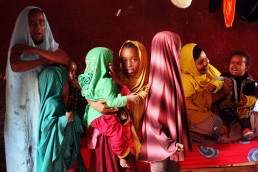
In the district MCH, health work is underway, and women and children queue in long lines to get free medical treatment, including the polio vaccination. Mothers with their children told me that the vaccination campaign is underway after several days of polio awareness work by UNICEF.

Once more, I escorted the vaccination team on door to door visits, and saw parents thanking the vaccination team for helping them to vaccinate their children.
Ismail Taxta is an Arete photographer based in Mogadishu, Somalia.
From the photographer: documenting polio vaccinations was originally published in Arete Stories on Medium, where people are continuing the conversation by highlighting and responding to this story.