


Documenting VIP visits — can your photos be interesting?
Documenting VIP visits — can your photos be interesting?
Security is a vital but constant concern for VIP visits, whether you’re working with government officials or celebrities, local public figures or international personalities. With often creativity-crippling security constraints imposed on the VIPs, how can one go about documenting VIP visits in an interesting and engaging way?
At Arete, we work with many non-governmental organisations (NGOs) and UN agencies: the World Food Programme (WFP), the United Nations Children’s Fund (UNICEF), the United Nations Development Programme (UNDP), and Sightsavers — to name a few. We conduct our work on behalf of these organisations in countries many other agencies are unable to work in, including South Sudan, Somalia, and the Democratic Republic of Congo — as well as easier to access countries like Kenya and the United Kingdom.

Documenting VIP visits is an integral part of the story behind many of the NGOs projects. VIPs can range from Country Directors from these NGOs, to national and international politicians, but a unifying factor for these VIP visits is tightly controlled security; this can pose a problem for photojournalists when trying to capture images unless careful planning is undertaken.
Do all VIP visits have to look the same?

Security constraints can range from limiting the movement of the VIP to the interior of a building, because often large crowds of people can turn out to see the VIP, which can make it difficult for security services to protect from threats of terrorism or violence; through to tightly controlling the people that VIPs can meet and interact with.
Without a creative approach, these factors can result in a portfolio of repetitive and ordinary photos. As a result, this can limit the effectiveness of the story one is trying to tell. What can we do, as photojournalists and storytellers, to mitigate these limiting factors?
Use reportage

A reportage style of photography is particularly useful if there is a high level of security around the VIP, and the VIP is confined to the ‘white-walled’ interior of one building for a visit. Reportage photos are less formal and portray their characters in a pose-free way that occurs naturally. Essentially they represent the opposite of the staged photos that are often required at these events.
Although the backdrop may not be unique or interesting, using this style, photojournalists can capture some great shots of the VIPs naturally interacting with attendees and stakeholders. If one focuses on capturing these softer moments of human connection — it will go a long way to telling an interesting and deeper story that will garner more support for your cause.
Work with the crowd

Although crowds of people can allow for the capturing of softer moments of human connection, they can also create a busy or messy background. This can detract from the image, making it much less visually engaging.
The shooting angle can play an important role in mitigating this. By shooting the subject from a lower angle, it is possible to frame the VIP on a less busy background — a good example of this is Kate Holt’s photo of Katy Perry above, which frames her head and shoulders against the blue sky.
Go beyond the shot-list
A shot-list often contains several staged events that involve the VIP, which are important to capture. These can range from ribbon cutting to shaking hands with stakeholders or giving a speech.

Stories about VIP visits can risk becoming repetitive and, therefore, uninteresting where only the same type of photos are captured. As a charity, foundation, or NGO, this will make it hard for your content to stand out from the crowd. This means avoiding lines up of VIPs and staged shots and employing the reportage style, as mentioned above.

This also means going beyond the set shot-list. At Arete our photojournalists take a different approach, expanding on the crucial shots that help tell more of the story. We seek out further elements of the story, whether it is a grouping of freshly grown watermelons that have sprouted as a result of the project; or a water tower donning the logo of the NGO or charity that funded it.

Talk to the experts
Despite adverse conditions, including security precautions and politically volatile environments, our photojournalists at Arete can call on their extensive experience (some of which we have shared in this article) to capture engaging and informative stories.
We can also advise on whether it would be more suitable to use of our local photojournalists who will be familiar with the culture, language and context or a photojournalist that can travel into the country with the VIP depending on the requirements of the client. To talk to us further about how to tell an interesting story of a VIP visit — get in contact here.
What is solutions journalism, and why should I be creating content in this way?
At Arete, we have a strong focus on “solutions journalism” and apply this to each assignment that we work on.
Last year, Arete trainer, Peter Burdin, explored how reporting through a solutions journalism lens can avoid creating ‘poverty porn’. In this article, we will dive deeper into this subject, exploring how a solutions journalism approach to content gathering can, amongst other things, combat donor fatigue and garner greater engagement.
But before we get into the benefits of a solutions journalism approach and why as a charity or NGO creating your content in this way can be beneficial, let’s first understand: what is solutions journalism?
What is solutions journalism?

The clue to solutions journalism is in the name; it is the reporting of responses to social issues where people, institutions and/or communities are working towards solutions. A good example of this is in our latest ‘From the photographer’ journal entry by Eden Sparke, which reports on the lack of employment opportunities for women in the DRC and how a scheme called #GiveWork aims to change this.
Journalists, charities, and NGOs have for years created content using problem-focused reporting. While this form of reporting does an important job of covering the social problems at hand, it doesn’t focus on initiatives that aim to provide help and support. Solutions-based writing refocuses the story on who may be working to solve the issue, as well as how and why the solution may be working (or in some cases, not working).
Why is it better to create solutions-based stories?

As a charity or NGO, great content engages people and energises support for your cause. A solutions journalism approach has been proven to help readers feel more informed, and more likely to carry out further reading on the subject as well as increasing propensity for the reader to share what they have read (1).
More detail around the solution = more engagement
Solutions journalism uses an investigative approach to understand why the particular social issue has arisen, and analyses what solutions are being implemented to solve it. By helping the reader or viewer understand in depth what is being done to solve the issue, one is more likely to engage them and gather their support.
By covering the story in more detail, one is creating more opportunities for the reader or viewer to engage with the content, whether through empathy, interest, or inspiration. Traditionally, the focus is on the solutions aspect of the social issue that is working; but even if the solution is failing, it still provides an honest and interesting insight for the reader about what hasn’t worked and therefore what could work in the future.
A solutions perspective can tell a more positive story

Reporting on social issues from a solutions perspective can also allow for a more positive approach to telling a story. Positive stories will always have a greater impact and are much more likely to be shared online (2). A more positive approach to storytelling will help your content stand out in an industry that too often reports on social issues in a way meant to elicit shock from the reader or viewer.
These aspects of solutions journalism can ensure your content stands out in a sea of problem-focused reporting, create more support and awareness for your cause; with readers and viewers more likely to share content created in this way, and combat donor fatigue by providing a more engaging prospect for your readers and supporters.
How we can help

We have outlined what solutions journalism is as well as touching on some of the benefits of creating content from this perspective. However, there is much more to know and understand about solutions journalism.
If you have a project that you think could benefit from our solutions journalism approach, or you would like to learn more about this topic in one of our workshops, then please get in touch.
Sources:
1. Curry, A.L. and Hammonds, K.H. (2014) The power of solutions journalism. Engaging news project.
https://mediaengagement.org/wp-content/uploads/2014/06/ENP_SJN-report.pdf
2. Tierney, J. (2013) Good news beats bad on social networks. The New York Times.

From the Photographer: First time in DRC
- Eden Sparke
Early one morning in May, I took a short flight from Nairobi to Kigali, before driving through northern Rwanda to the border with the Democratic Republic of Congo (DRC). I was due to visit the workshop of a man called Theodore, an experienced tailor who trains others under the auspices of a concept called #GiveWork.
I had been warned that driving through Rwanda before crossing into Goma would be a shock; three people unnervingly used the phrase “like going from heaven to hell”. The warnings were not entirely untrue; after three hours of driving through stunning forest and mountains, I was greeted at the DRC border by temperature checks and a tannoy system loudly reminding passers-by to wash their hands at the chlorinated water stops. The country’s most recent and biggest ever Ebola outbreak, which seems so far away in the UK, suddenly loomed large.

After making it into Goma unscathed, we drove through the chaotic traffic to the workshop. Theodore, a tall, regal man only just in his sixties, greeted me warmly before giving me the run of the place, where people were working on the latest order for Pour Les Femme, an exclusive sleepwear brand that supports #GiveWork and produces a capsule collection of pyjamas in DRC. Everyone in the workshop was busy cutting, sewing and pressing pure white fabrics that contrasted heavily with the thick grey dust covering the floor.
I began taking photos, paying mind to the mid-afternoon light that shone through the large windows and bounced unforgivingly off the cream-coloured walls. The tailors, who glanced at my equipment before fastidiously returning to their tasks after I had introduced myself and asked the Swahili equivalent of ‘pretend I’m not here’, relaxed after a few minutes and began asking me to observe what they were working on.

I also took the opportunity to interview Theodore. His office, a tiny room to the side of the main entrance, just about held his chair and two stools for myself and Cherubin, my translator. The background noise to the captured audio featured the whirr of sewing machines and the occasional stifled laugh, but overall it made a great place for an interview.
It was in this room that I discovered Theordore’s motivation for having trained over 50 people in tailoring. “I am proud of the people that work around me, and I am proud that when they leave here, that they will be ready to be independent,” he says. “All of humankind are called to God one day — I am proud that I have people who will keep doing this work in my absence.”

I returned to the workshop the next day, and in the early morning light saw Theodore’s son and senior tailor, Elysée, poised to turn on the generator. After his confusion at me wanting to photograph him pressing a button wore off, he started up the generator, which roared into life and allowed the workshop — at a cost of over ten precious dollars per day — to begin functioning.

After taking advantage of the softer morning light for wide and portrait shots, I also spoke with Fifi, the widow of a Virunga National Park ranger who had been murdered by bandits years before. After her husband died, she found it difficult to support herself and her two children. “I had to work in the fields for around 1 dollar per day,” she explains. “Sometimes my children were sent home from school, and I had to beg the teachers.”
Fifi learned to sew on a programme, where she met Theodore, who was one of the trainers. Following the training, she had the opportunity to create the first and second capsule collection for Pour Les Femmes at the Virunga National Park facilities.

That afternoon, we visited Theodore’s home. Located 90 minutes on foot from the workshop, in an area with no running water or consistent electricity, Theodore’s four-bedroomed home is home to 10 people. While sharing a loaf of bread, Theodore’s family told me of their plans to move closer to town, hopefully into a five-bedroomed house. His wife, Adeline, showed me their small kitchen, and the bucket and hose they used to collect rainwater to avoid going to the public tank, about 10 minutes’ walk away. It seemed strange that a man working so hard to do so much good should be living in such difficult circumstances.
On my penultimate day in DRC, I visited another workshop, run by local association AGAPE, which creates accessories for Pour Les Femmes and where Theodore used to work. As people filed in, I began to photograph the embroiderers, who were tacking names onto cloth that would be made into make-up bags. Children played in the compound outside, and it seemed far away from the noise and chaos of the part of Goma that I had become used to.

I found a helpful whitewashed wall and began asking people to come and pose for photos for me. Standing in an area looked in on by the workshop, they were understandably nervous about posing, but once again Cherubin came to my rescue, cracking jokes and helping them to relax enough to provide some beautiful portraits. I struggled more with the lighting inside the workshop; despite the glaring sunshine outside there were areas that were incredibly dark. Part of my learning curve was understanding when to focus my efforts elsewhere.

My final day was a mad rush to visit Don Bosco — a sprawling orphanage for babies and children up to the age of 18. After being tasked with taking portraits of the younger children who were undergoing vocational training in the compound’s workshops, we found that they had all disappeared to sit their school exams. Luckily the Programme Manager, Monica, rounded up a group of — at first slightly unwilling — young men and women to have their photo taken and to explain to me why the lack of consistent electricity in the area posed such a problem for them.
I spent barely three hours there before being whisked back off to the border on the news that the Rwandan president was visiting Gisenyi, the Rwandan crossing point, and shutting all the roads down as he went. It was a fleeting end to a visit that felt equally as quick.

For all the warnings I received, Goma and its people felt welcoming, if chaotic. Even after spending barely a week there, the potential of the region is obvious; there is an energy that permeates the town even through the complex web of poverty, conflict, and yet another Ebola outbreak. People are motivated to educate themselves and to work, but they are being held back by a systemic lack of job opportunities. Schemes like #GiveWork are vital, because they empower people who have been disenfranchised by forces beyond their control, and allow them to create a sustainable future for themselves.
From the Photographer: First time in DRC was originally published in Arete Stories on Medium, where people are continuing the conversation by highlighting and responding to this story.

From the photographer: working in the aftermath of Cyclone Idai
- Philip Hatcher-Moore

The immigration official at Maputo International Airport looked over my visa form, and asked me what sort of trucks I was visiting in Beira. I had written down “TRUK” on the form — the acronym for Team Rubicon UK — and she seemed mildly amused, or confused, that I would have travelled all this way to look at some beaten up wagons. It transpired that her misunderstanding would be rather prescient; 24 hours later I was sat in the cab of a dumper truck, loaded to the hilt with several tonnes of humanitarian aid, rumbling from Beira to the interior through the night.
I was in Mozambique to document recovery efforts after Cyclone Idai ravaged the region in mid-March, travelling with Team Rubicon UK, a charity comprising volunteers, many of whom are ex-military. It was soon evident that their approach was drastically different from many of the larger charities working there, from the military nomenclature imbued in their operation, to their idea of “comfort” in the field. I split my time in Mozambique between their two, four-person “strike-teams”, which were charged with delivering aid to isolated communities.
I had worked on the aftermath of the cyclone in Zimbabwe and Malawi several weeks previously, but it was Mozambique that had borne the brunt of Idai’s rage. Further north Cyclone Kenneth had just battered the country for a second time. Country-wide, some 1.85 million people have been affected by the cyclones, according to UNICEF. In its wake, Idai has brought a cholera outbreak, and cases of malaria have risen sharply, with more than 25,000 cases reported so far.
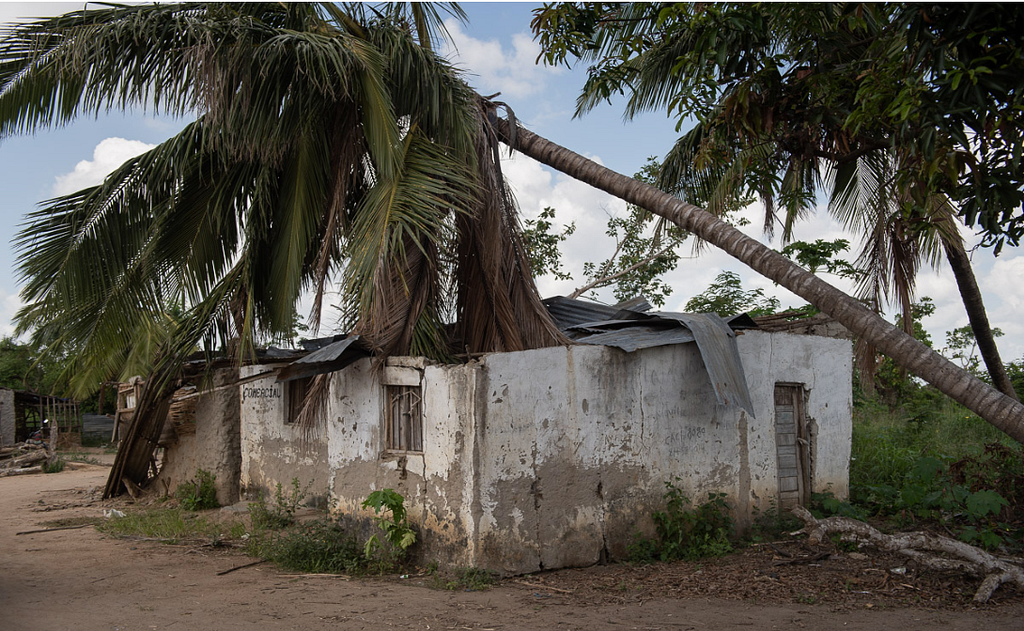
One of the biggest challenges aid organisations have faced is simply trying to reach the people that need their help. Even after the floodwaters receded, some communities remained isolated for weeks; sections of highway and bridges have been washed away, and tight, winding dirt roads have been bogged down in mud and blocked by fallen trees. These were communities that lost everything.
Martha Paolo, a nineteen year-old mother of two, lives in the village of Gaubolene, a few hours’ drive from Beira. “This is the first time we’ve seen anything like this here,” she told me, through a translator. Even the oldest people in her village couldn’t remember a storm as bad as this. Warnings had come through on the phone, but no-one here expected to see anything of the magnitude of the chest-high floodwaters. “We tried to protect ourselves in the house, but the storm blew the roofs off,” she said. “There are many families that lost all their family members.”
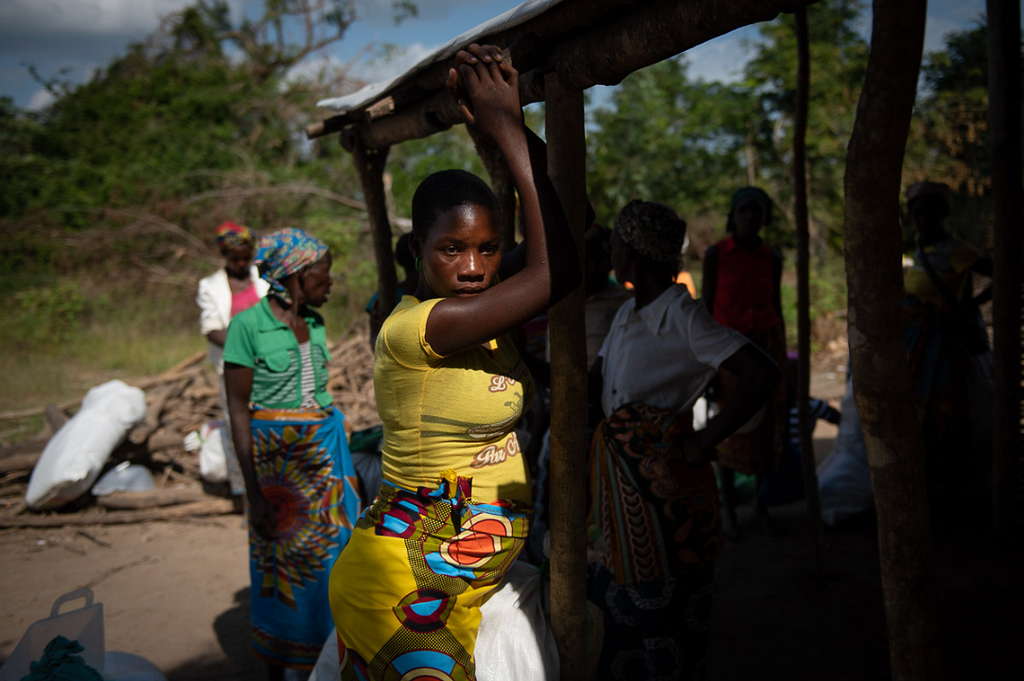
As the waters rose, Martha, who is several months pregnant, took her two children and climbed a nearby tree, covering herself and her children with a blanket — their only protection against the storm. The family spent the entire night in the tree, and the following day, braved the gushing waters in search of higher ground. “We couldn’t save anything from the house,” she said. “We lost everything.” The house was washed away, along with all their belongings, and the family’s crops were drowned in the flooded fields.
Martha said it took a month for the first aid to arrive. Trees had fallen, blocking off the tracks that led to the village. They had had one drop of food aid, and the community helped each other out with jerry cans and cooking pots. A week before I met Martha, John Zoumides, a former army medic who now volunteers with Team Rubicon UK, had arrived in the village on a helicopter recce. After speaking with the local chief, the team organised to come back with kits to help people get back on their feet: jerry-cans, blankets, solar lamps and other items. I rode along with them as they were bringing it all in.
“Improvise, adapt, overcome”
Earlier in the week, I had spent time with Team Rubicon UK’s other strike team — the aforementioned arduous all-night truck ride. We had to negotiate rickety, makeshift bridges and detours around washed-out roads, the convoy blew a tyre, and I had to climb out of the cab to hoist fallen telephone lines clear of the truck.
Paul Taylor served in the infantry of the British Army for 26 years, and has turned his career to disaster response and humanitarian aid; a Team Rubicon UK veteran, he had led this mission from the first deployment. When our truck rolled in to the dusty, barren village of Bandua one morning at 5am, it was Paul that met us, a head-torch on, having just emerged from the mosquito dome in which he had spent the night.

Paul and his team were not afraid to rough it, nor of getting stuck in with whatever needed doing. They hired labourers to help unload the several tonnes of aid, but were right in the middle of them, sweating it out in the midday sun to get everything unloaded. When the trucks got stuck in the sand, they were there digging them out. And symbolic of the respect they had for the community they were helping, as soon as the trucks were out, they grabbed shovels and filled in the trenches left by the spinning wheels. In all my years spent getting stuck on bad roads in far-flung places, I have never seen someone pick up a shovel to leave an area just as they had found it. I often heard Paul utter his mantra — “improvise, adapt, overcome” — when faced with problems. And this is exactly what his team were doing, day-in, day-out.

Back in Gaubolene, John was having to improvise, adapt, and overcome, too. A culvert had collapsed on the main road — a 4x4 could drive through, but not the big wagon that was bringing in the aid to Martha and the rest of the population. And further along, the road narrowed, until eventually it was swallowed by the stagnant flood waters.
John jumped out of the pick-up truck, and arranged for it to shuttle back and forth, between the truck and a school, bringing in a few kits at a time. Meanwhile, he rounded up a group of motorcycles to bring him and more than one hundred jerry cans to the village, several kilometres away. If they couldn’t get all of the aid to the village, they’d bring the village to the aid.

Families were arriving on foot as pick-up trucks ferried-in the supplies, congregating on the football pitch of the local primary school. The school was on slightly higher ground, so had escaped the flooding, but the rustic buildings had taken a battering by the winds, their roofs blown off, and some classrooms had collapsed.
Jordão Alficha was in the corner of the site, steadily fashioning a structure for a new classroom with a machete. He was not the sort of man to wait for assistance to come — it could be months, years even, before the school received any sort of help to rebuild. So this teacher was taking matters into his own hands. The classrooms he could fix, but his bigger concern was the damage caused by the storm to the school’s solar panels — the only source of electricity this far out in the bush. These were something he couldn’t repair.

“Your mother is a donor”
With the trucks emptied, Paul and John’s respective teams travelled back to Beira, where they had set-up base. It’s common for aid organisations to take over hotels and apartment complexes in disaster zones, often resulting in lucrative deals for their owners.
This was a somewhat different set-up.
In an empty bar-room of a local beach club, Team Rubicon had set-up their mosquito nets on the floor, living out of the kit-bags with which they had flown out, sharing the space with a contingent of Brazilian firefighters who had also come to help the relief effort. The owner of the complex had welcomed disaster responders, and Paul and the team had struck up a relationship with him, each of them simply wanting to do what they could to help people in need. Everywhere they went, their spirit of volunteering spread to those they met, and through these collaborations, things were achieved.
The idea of squeezing the most out of every penny donated seemed to be at the core of how Team Rubicon operated here. The seven responders working alongside Paul were all volunteering their time to be out here, taking time off work, and keeping their living costs to the bare minimum. They were sleeping on the floor, negotiating contracts for trucks and cars as hard as possible, and pushing every day to get as much work done as they could, all whilst living off one meal a day — often a dehydrated ration pack cooked over a camping stove far from the nearest bed. They knew that the people they had come to help were living in much harder conditions, and so had little time for luxuries.

I have at times become somewhat disenchanted by the waste and inefficiency of some of the responses witnessed in the myriad conflict and disaster zones I’ve covered across the continent. It was refreshing to spend time with a group of people who simply wanted to help: to get their heads down, and get things done. They said they felt proud, and privileged, to be out helping people, and they lived by their organisation’s values: “your mother is a donor” — in other words, don’t waste a penny.
After a week with with the team, I was flying back as they ended their mission. The flight home for me would take the best part of 24 hours. As I stood waiting for a coffee at the airport, I made small-talk with a salaried NGO worker in the café. She talked about her flight out to Mozambique, and how she had sent the available routes to her boss. “Just take the shorter one,” had been the response. “It’s only an extra £300.”
From the photographer: working in the aftermath of Cyclone Idai was originally published in Arete Stories on Medium, where people are continuing the conversation by highlighting and responding to this story.

Photographing people in a medical setting: how and why to do it
Photographing people in medical settings: how and why to do it

Arete translates as knowledge. An area where knowledge is key is photography — particularly when it comes to photographing people in medical settings, such as hospitals and clinics. Without the right set of skills and knowledge more harm than good can be done by photojournalists.
We work with some of the world’s biggest non-governmental organisations and charities, gathering stories on their behalf. It is therefore of the utmost importance that every piece of information our journalists and photographers gather has the patient’s wellbeing in mind and adheres to an ethical code.
Following on from our previous blog by Arete photojournalist Karel Prinsloo, we discuss some of the key points in photographing people with medical issues.
The well-known saying ‘a picture speaks a thousand words’ still holds true when it comes to photojournalism. It is no secret that the world’s NGOs and charities must fund-raise in order to provide free support to people in critical and life threatening situations. This is where original photographs come to the fore; there is no medium that tells a story better than a still image.
It is key that how and why these photos are being taken is communicated to everyone involved, and consent is given before any photography takes place.
Consent
Asking for consent from the patient, the patient’s next of kin, or the director of the medical facility should always be the first port of call for any photojournalist. Who consent is obtained from will be dependent on the situation of each patient. If the patient is unconscious, or devoid of mental capacity, then consent can be sought from the appropriate guardian — be it the person in charge of the medical facility or their next of kin.
An integral part of the process of asking for consent is explaining how and why these photos are being taken, how they will be used and by which organisation or charity.

Observe, don’t interfere
A photojournalist in this situation is ultimately there as an observer. Being mindful and aware are two of the most important attributes a professional can have when photographing people in medical settings.
It is always best to observe from a distance and to not get in the way of medical staff in an emergency. Be aware of the impact you are having by simply being present with your camera, always aim to avoid causing harm or distress.

Dignity
Aiming to preserve the dignity of the patients should always be a high priority. From a technical perspective this means using equipment such as a long range lens, so as to avoid getting too close to a patient and invading their personal space. From a human perspective this means being conscious of how your actions or intentions are impacting upon the person, and those giving them care.
Before starting to take any photographs it is important to spend time with the patient, talking about anything other than their medical condition so you can gain their trust. When it comes to taking the photographs don’t focus only on the visibly affected areas of the body.
If required there are also various techniques that can be employed to preserve the anonymity of the patient too — such as not capturing the patient’s face in full, the eyes, or any identifying tattoos or hospital tags.

Using the photos
Employing a code of practice and ethics is just as important when choosing which photos to use as it is when taking them.
An example of this can be seen in the New York Times reporting of the terrorist attack on the Nairobi hotel-office complex in January of 2019.
The decision was made to publish photos of a number of the victims who died. The ensuing backlash from the people of Kenya and elsewhere in the world showed how unethical a decision this was.
Ultimately, here at Arete each of our photojournalists operate in accordance with their own code of ethics — some of which we have explained in more detail above. Only photos that fall in line with those ethics will be presented to the client. Although which of those photos are used, or not, always remains the client’s decision.

At Arete we source and manage local experts in photography, video, digital and written content from around the world to help tell stories that make a difference. To discuss photographing people in medical settings in more detail, or how to tell a story of your own, you can get in touch here.
Photographing people in a medical setting: how and why to do it was originally published in Arete Stories on Medium, where people are continuing the conversation by highlighting and responding to this story.

From the photographer: Photographing tropical diseases
- Karel Prinsloo, Arete photographer based in Johannesburg
In early April, I set off for the Democratic Republic of Congo (DRC) to join a mission with Sightsavers, an international charity that helps people affected by avoidable blindness.

Once in the country, I travelled with Dr Diana Joana Kaningini from the DRC Ministry of Health, and Dr. Alice Mutekwa, the United Front Against Riverblindness (UFAR) project co-ordinator in Katanga, a partner of Sightsavers.

I have seen pictures before of people living with elephantiasis (lymphedema), but nothing could prepare me for the reality of meeting patients who suffer from this disease.
The first person we met was a woman with some swelling in her leg, caused by lymphatic filariasis (LF), a disease caused by thread-like nematode worms spread by infected mosquitoes. I thought ‘Okay, this isn’t too bad’. But throughout my trip, the cases became progressively worse.

On the second to last day, as we travelled, we came across a woman called Marie Mwape. Her leg was in really bad shape and had some open sores. Our team decided to return the following day with the necessary medication to help her.

The next morning we met her and her husband at a medical facility about 60km away from Lubumbashi. I could see that Marie was nervous, and her husband stood in the far side of the room, uncertain what was about to happen. With great tenderness, Dr Diana start to clean Marie’s swollen leg, gradually washing away the layers of dirt to show the true extent of her injuries. Along with the swelling of her leg and foot, she had several open wounds on her ankle.

She told us that she has lived with this condition for twenty years. It struck me that she was not aware of what had caused her illness, as is the case for most people who we met along the way. People typically use traditional medicine to treat the problem, as they either do not trust modern medicine or, as in most cases, cannot afford it.

I took a portrait of Marie as her feet was cleaned and I noticed that she was a striking woman, with only her feet giving away her terrible circumstances. She handled her situation with dignity and grace, and smiled as I photographed her. Even with the help of modern medicine, her condition is irreversible, as treatment can only stop the disease from spreading further into her body.

This is in contrast to some of the male patients we met, who were suffering from another complication relating to LF, known as hydrocele — a type of swelling in the scrotum. Hydrocele, unlike elephantiasis, can be cured with a simple operation.

Despite its easy treatment, the stigma and misinformation surrounding hydrocele can have a terrible social impact upon those it affects. Some of the male patients we talked to had lost their spouses, and were being shunned by their community. The operation is the first step for them in rebuilding their lives.
Lymphatic filariasis takes a terrible toll on the communities it affects, and it is indiscriminate. A person’s fate is often decided by where they live; most of the patients live near water and do not have access to health facilities. A simple bite from a mosquito and they are condemned to dealing with a life-long illness.

As a photographer, I found people were open to being photographed even though some of them have serious physical symptoms caused by their diseases. I always make sure they are happy for me to take their photograph, though nobody said no. However, I try as far as possible to use a longer lens, which allows me to stand further away and lessen the intrusion into their personal space. I also find it important to focus on their faces, to show them as human beings, rather than to focus purely on their disability.
What struck me most during this assignment is that the people I photographed have mostly accepted their condition, and carried on with their daily lives. They have continued to work, and care for their children and family; no time is spent thinking about why this happened to them in particular.
This type of work takes a heavier personal toll on me these days, since having had children. I see the difficulties faced not only by the people affected by the disease, but of their families too, especially children. It is unfair that people have to live with diseases like this in 2019, when so much can be gained with just a small amount of medical attention. Unfortunately, in many of these kinds of places, people just do not have any access to medicine.
More information about Lymphatic Filariasis
Lymphatic filariasis, commonly known as LF, is one of the world’s leading cause of physical disability. It is estimated that up to 120 million people in 83 countries worldwide are affected by some form of filariasis. It is caused by parasites, transmitted to humans by mosquitoes. The disease can result in an altered lymphatic system and severe swelling in the limbs (lymphedema) or scrotum (hydrocele). Patients suffer painful attacks where they often can’t work or move around. Patients can be taught to manage lymphedema so it doesn’t progress, but it’s not reversible. Hydrocele can be cured with a simple surgery.
Karel Prinsloo biography
Karel Prinsloo is an award-winning African photographer. He was born in Namibia, and has over 20 years’ experience working in Africa as a photographer. Based in Nairobi for nearly a decade for the Associated Press as their East Africa Chief Photographer and Picture Editor, he has extensive knowledge of Eastern and Southern Africa as well as the Middle East.

From the photographer: Photographing tropical diseases was originally published in Arete Stories on Medium, where people are continuing the conversation by highlighting and responding to this story.

From the Photographer: Covering Ebola in DR Congo
For several months I had been discussing a potential trip with the humanitarian organisation Medair to visit their projects in Eastern Democratic Republic of Congo and their response to the ongoing Ebola outbreak. My initial plan was to travel to Goma in December, but the upcoming elections in Congo posed security concerns that may have impeded my ability to visit the projects I wanted to see.

I witnessed first-hand the devastation Ebola had caused in West Africa; having worked throughout eastern DRC between 2004–2005 I was keen to see how communities there were coping with the outbreak. The region had been riddled with violence an ineffective government for years and massive displacement had caused traditional coping mechanisms to be reduced.
The latest Ebola outbreak in eastern Congo, the second deadliest in history, has entered its seventh month, with 807 confirmed cases, of which 483 have resulted in death. The disease is moving toward the major border city of Goma; a city of nearly 1.5 million people. This development would greatly complicate any hope of stopping the virus’ spread in the unstable region.
By the end of January the election results were finalised and tensions were starting to calm. The Ebola outbreak still raged, however, with between 3–14 new cases being reported every day. Medair had been working in Beni and Butembo — the regions affected by the outbreak — for the last six years, so had existing programmes that could be expanded to meet the challenges of containing the outbreak.

One of the reasons I love working with Medair is the warm welcome their staff always give you. I have visited their projects working with Syrian refugees in Lebanon, in Somalia, and have undertaken photography trainings with their communication staff. At the first morning meeting I attended in Goma, I was invited to join the morning prayers — The Congolese love to sing and are incredibly musical. They were all so positive, despite the challenges they faced every day in combating the outbreak.
I was accompanied on my visit by Pete Harrison from the Communications and Fundraising team. We flew together on the daily UN flight, landing on the UN military base just outside of Beni. There have been ongoing security issues in Beni; one of the Medair-supported health centres was attacked and burnt to the ground in December. Seven Medair-supported health centres have been attacked and burnt or looted in North Kivu since November, along with several others supported by other organisations.

Everywhere along our journey there were handwashing stations: at the entrance and exit to the airports; entrance to offices; and at every UN and government building. It was very reminiscent of the outbreak in West Africa. Small amounts of bleach are diluted in the water to ensure that any trace of the Ebola virus is killed should you have it on your hands. After five days of washing my hands and nails were spotlessly clean!
It’s also interesting to note that one of the upsides of the Ebola outbreak in West Africa, was that the cases of diarrhoea decreased in communities where handwashing was implemented. It is thought that this was because of the improved hygiene standards as a result of frequent handwashing.

As we arrived Beni as the number of cases continued to rise . A case had just been confirmed in Bunia and several had been confirmed further south, on the road to Goma. The outbreak had first been declared on 01 August, and I was in Beni for the six-month anniversary. By this point, over 500 peopled had died and nearly 800 infected, and there were fears that the outbreak was getting out of control.
I was told that the WHO was currently engaging its sixth strategy in the outbreak. The methodology employed in the western DRC outbreak hadn’t been effective in the east; the context was too different and security problems with rebel groups had hindered the ability of vaccinators to reach communities, and safe burial teams to carry out funerals.

The Ebola vaccine is transforming the way NGOs are able to respond to the outbreak. It has been a massive development since the outbreak in West Africa — when no vaccine was available — meaning frontline health workers were in danger of catching Ebola from patients. Nearly all of the Medair staff in Beni had volunteered to have the vaccine, which gave them a sense of security against contracting Ebola when going about their daily work.
Micheline, who worked in the Medair procurement department, told me that she felt much more confident and able to do her job since she’d had the vaccine. She pointed out that when the staff were all vaccinated, it was only the men who complained of feeling ill afterwards and took time off work — whereas the women were able to keep on doing their jobs!

It was fascinating to see first-hand the challenges being faced by the NGOs and UN agencies trying to stop the spread of Ebola. Sara Philips, the Medair Ebola response coordinator, was adamant that security wasn’t the only reason that it was proving difficult to get on top of the outbreak, and that much more engagement with local communities was needed. She explained how Medair was dong this through engaging with communities and providing education to traditional healers and community groups who were are the forefront of the outbreak.

I was taken to Mbau, one of the epicentres of the outbreak where Medair was working in the local health centres. They had helped the centre to set up a screening unit and establish infection, prevention and control measures through handwashing stations and hygiene promotion.

To get there we had to pass through a checkpoint on the road out of Beni, where we all had to get out of the vehicles, wash our hands and have our temperatures taken. These checkpoints exist all along the road down Eastern Congo at the moment, in the hope that anyone infected with Ebola will be screened in an attempt to stop the spread.

Nothing can prepare you for meeting a parent who has lost their child to Ebola. We met Papa Kambala in Mbau. His daughter, a school teacher who lived with him, had contracted Ebola before Christmas and died shortly afterwards. He told me “My daughter was the one who supported me but now she is gone I am alone to care for my three grandchildren. Life has been hard. All I want to do now is dig my own grave and die.”

His daughter had lived with him and helped to look after his three orphaned grandchildren, as well as supporting him financially. After her death, the house was sterilised and all mattresses and cushions were destroyed; he was given a new mattress by the Ministry of Health, but no new cushions.
I also met 65-year-old Agwandia Jermanine, who had survived Ebola at Christmas time. She was determined to teach others about the importance of early detection and treatment, through speaking at community meetings organised by Medair.

It was evident from my visit to Mbau that Ebola wasn’t the only challenge facing this community. I met Marie, sitting on a bed with her baby, who was suffering from a convulsions.

Marie had been forced to flee her village in a village 25 kilometres away after it was repeatedly attacked in September. During one of the attacks, her husband was killed by rebel soldiers, and she lost everything. She is now living with her eight children in rented accommodation, and has little money to buy food or pay for any of her children to go to school. She is frightened of catching Ebola and this prevented her accessing treatment earlier with her daughter.
The international response to the Ebola outbreak has been huge. Millions of dollars-worth of help has flooded into the region to try to curb the Ebola outbreak since last August. Yet it struck me that for years, people like Marie have suffered displacement, poverty and violence. Thousands of people have died because of the war and lack of access to quality healthcare, before this outbreak began.
About the photographer
Kate Holt is the founder and director of Arete. For the last twenty years she has photographed regularly for numerous NGOs — including UNICEF, Care International, Jhpiego, the International Red Cross, MSF and OXFAM. She is a regular contributor to the Guardian and the BBC.
From the Photographer: Covering Ebola in DR Congo was originally published in Arete Stories on Medium, where people are continuing the conversation by highlighting and responding to this story.

From the Photographer: working in SE Asia as a documentary photographer
- Lewis Inman, Arete photographer
Language, heat, moisture and more moisture.
Can I take your photo?
Across Indonesia, over 300 different languages are spoken. As a photographer, you will almost certainly need a translator who can speak the language of the ethnic group that you will be working with. But finding someone with professional translation experience outside of a big city can be difficult.

Translator or not, a critical sentence to learn in the local language is “Can I take your photo?” as this helps to build a relationship and can help to spark a conversation. Just make sure not to say the sentence too well, as people sometimes assume you are fluent, which can be quite embarrassing when it turns out you most certainly aren’t!
You may pick up the local language quite quickly, but then find yourself on another assignment in a different area, with an entirely different dialect. This has been the case with all the cities and villages that I have worked in or visited across South-East Asia. The key is to remain adaptable — try to pick up a few key phrases wherever you are and build up your base of translation contacts.
Culture vulture
Having spent the majority of the last four years in South-East Asia, I have developed a good understanding of the culture and the way things work. For instance, it is critical to understand prayer times in Muslim countries. You need to be aware that the people you are working with might need to stop what they are doing to pray, and to be able to time interviews and travel around this.

One of the things I have found helpful is my love of food! Having a passion for food somehow gives me a good understanding of local culture when I first arrive somewhere. All you need to do is visit a local market or a local street food hotspot when you first arrive — this can give you a good understanding of how the place works, which can come in very handy in the long run when you are out and about taking photos.
Heat and humidity
As expected, South East Asia is, in general, very hot. Shooting will make you tired and achy, and in between shoots you will most likely be travelling, most of the time on dangerous and uncomfortable roads. So it goes without saying that keeping hydrated and out of the sun is essential.

But those new to this type of environment might not realise the problems of extremely high humidity, which can be incredibly dangerous for cameras and laptops, and before you know it, that expensive laptop starts failing, the metal starts to corrode, and the whole thing eventually dies. It is always essential to have spares, backups and workarounds in case of emergencies. Use silica gel and waterproof cases to keep your equipment as dry as possible (and bring plenty of the former — it’s not often you come across an obliging oven in which to dry out your silica packages!).
Of course, it’s all very well telling you to pack two of everything, but bear in mind that an assignment begins before you start pointing your camera at things — it starts in your suitcase. Plan ahead, travel as light as possible and make sure that everything you have is functional and necessary. As if worst comes to worst — know if and where you can get a quick replacement to mitigate against any equipment failure.

Working as a freelance photographer in South East Asia — or any new region — will always present its own set of challenges. Some problems are universal, some specific to the place you will be working in: the key is research, research, research. And then, be flexible!
Yes, South East Asia can be a daunting place to work in sometimes, but there’s a reason I keep coming back, both as a photographer and in a personal capacity. It’s an extraordinary area with so much life, culture (and food) to see that I can’t imagine I’ll ever feel ‘done’.
Lewis Inman is an award-winning documentary photographer and filmmaker born in London and now based in the Philippines, covering social issues and commercial commissions worldwide. Lewis received a 1st class honours in Photojournalism & Documentary Photography from University of the Arts London (LCC). Lewis has won many awards including first place prize of the Symons-Hatton Award, recognising his “commitment and dedication to Lens Based Media”. He has been working in South-East Asia with a range of clients including Team Rubicon UK and the DEC on behalf of Arete.
From the Photographer: working in SE Asia as a documentary photographer was originally published in Arete Stories on Medium, where people are continuing the conversation by highlighting and responding to this story.

From the podcaster: Gathering stories in Lesotho with Jhpiego
- Eden Sparke
Since podcasting took off in late 2004, ‘audioblogging’ has grown exponentially, and today there are over 550,000 podcasts published on various platforms, catering to audiences around the world.
Podcasts represent a welcome diversion from the screen-centric world we have found ourselves in. Instead of staring into your phone for the entirety of a commute, we can now dive deep into stories, catch up with the news, and learn new skills through our headphones while taking in the world around us.
Arete is seeing an increasing demand from clients keen to break into this market. Non-profits are always striving to tell stories direct from the people they work with, and podcasting is a great way to do this — hearing someone telling their own story, in their own voice, provides an authenticity and intimacy that you cannot get from reading words on a page.

With this in mind, I set off in November with Arete photographer Kate Holt to the small, landlocked country of Lesotho, to gather stories from people affected by the country’s HIV epidemic.
Lesotho has the second-highest rate of HIV prevalence in the world, with over a quarter of the population testing positive for the virus. But myths and stigma around HIV are still rife, meaning many avoid testing and treatment.

On my first day, I met with two female sex workers, who are the most at-risk group for HIV infection in the country, with 72% being HIV positive. Limakatso, a tall, proud-looking woman, tells us about the conditions that she works in; enduring police brutality, men who refuse to wear condoms, and competition between sex workers for clients. She speaks in a matter-of-fact manner, even when she talks about subjects that many people would find emotionally draining to deal with on a daily basis.
But it’s when she speaks about her peer education work that her voice takes on a different tone. When I hear her speak the line that would subsequently be translated as “When I realise that someone has taken my advice, I feel like a champion!”, I sense the pride and energy in her voice. Editing it into the podcast brings a wonderful sense of hope to end a story punctuated by sad and sometimes brutal events.
The next day, we meet two members of another high-risk group — young women — about their use of the HIV prevention drug, PrEP. Mphao, who is 18-years-old and has just begun work as a radio presenter, began to take PrEP out of fear that her night job as an MC might lead to her being attacked and infected. She is articulate, speaks perfect English, and isn’t afraid to give us a deep insight into her thought process and feelings around HIV.

“All this time I’ve always been wondering, ‘okay, it’s a pill you take daily, what difference does it make from taking other ARVs?” she says. “It’s almost the same.” It’s moments like these, captured on audio in real time, that allows a direct connection from the listener to her thoughts and feelings.

21-year-old Limpho has the same openness when interviewed about why she feels so many people in Lesotho — nearly 20% — don’t know their HIV status. “Most girls say, if I know my status, it’s not going to change anything physically,” she says. “Because their main concern is ARVs. They’re like, ‘if I don’t take ARVs, nothing’s going to change.’ Like they have a belief that if you take HIV ARVs that you’re going to be fat, or something’s going to change physically.”

Finally, we meet Tsotleho, a nurse at Jhpiego-run all-male clinic on the outskirts of Maseru. He speaks to us at length about the issues that men face while accessing healthcare, giving an insight that would be very different to those of the 80% of healthcare workers in Lesotho that are female.
“Given the strong cultural background of our people, men are very secretive,” he explains. “They don’t think they can talk with the females, whether they are health providers or not. So they tend to hide lots of health issues that concern them, especially reproductive and sexual health - they don’t disclose to females.”
Gathering perspectives like this, from groups that are typically underrepresented in arenas like development, government and healthcare, can only benefit organisations. It can uncover and provide solutions to problems, allowing interventions — wherever they originate from — to be more closely aligned with the needs of those they are targeting. The voices of those affected by the issues that NGOs and others are seeking to combat should be amplified, and podcasts are a fantastic, and innovative, way of doing this.
You can listen to the podcast series here.
Biography
Eden Sparke is Production Lead at Arete. When not recording and producing podcasts, she is editing videos for clients like UNICEF and World Health Organization, and honing her photography skills.
From the podcaster: Gathering stories in Lesotho with Jhpiego was originally published in Arete Stories on Medium, where people are continuing the conversation by highlighting and responding to this story.